
Menu
As enterprise environments place higher demands on wireless communication—particularly for real-time audiovisual applications—the stability of wireless presentation systems has become a critical evaluation metric. Boegam’s flagship wireless presentation solution, the E900P receiver paired with the F21SU transmitter, is engineered specifically to deliver consistent low-latency performance under complex RF conditions.
Recently, a European partner raised professional questions regarding 5GHz DFS channels and the wireless architecture inside our devices. This technical article provides an in-depth explanation of how the E900P and F21SU handle channel allocation and how the wireless communication pipeline is designed for stability and robustness.
The 5GHz Wi-Fi band includes a set of frequencies known as DFS (Dynamic Frequency Selection) channels. In the EU and many regions, DFS channels (52–64 and 100–140) are shared with aviation radar, weather radar, and military radar systems. Devices operating on DFS channels must detect radar signals and immediately switch channels when necessary.
This requirement introduces several disadvantages for real-time wireless presentation:
Possible sudden channel vacating
Increased reconnection time
Mandatory radar scanning before allowing transmission
Higher risk of mid-session interruptions
For applications requiring stable, continuous screen sharing, such as conferences, training, education, and BYOM collaboration, DFS channels are not optimal.
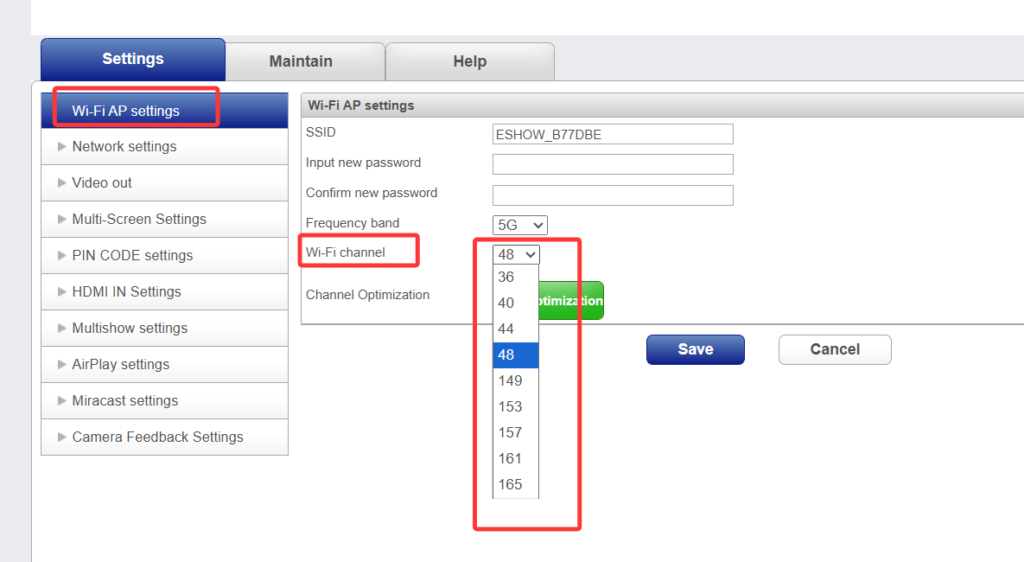
To ensure maximum reliability, Boegam E900P does not use DFS channels—neither through hardware nor software configuration.
36 / 40 / 44 / 48 / 149 / 153 / 157 / 161 / 165
These channels provide:
Fast connection time
No DFS radar interruption
Stable long-duration performance
Full compliance with enterprise environments
The E900P also features:
Manual channel selection via Web Settings
Automatic channel optimization, which scans interference and selects the best available channel
This guarantees stable performance even in dense wireless environments such as corporate offices, universities, conference centers, and government facilities.
A common assumption is that the system-on-chip (SoC) performs both video processing and wireless transmission. In fact, the E900P and F21SU use a modular wireless architecture, in which RF communication is fully handled by dedicated Wi-Fi chipsets.
The RK3566 in E900P serves as the central processor responsible for:
H.264 / H.265 video decoding
Multi-screen compositing (1–9 screens)
4K60 video output
BYOM processing (USB camera/mic/speaker transport)
System logic, device management, web interface
It does not handle wireless RF communication.
Wireless communication is implemented through industry-proven Wi-Fi chipsets, selected for high performance, anti-interference capability, and long-distance stability.
Ampak AP6275P, Wi-Fi 6 (2T2R)
Optimized for high-stability reception
Supports both AP hotspot mode and STA client mode
Enables 50m line-of-sight wireless range

Realtek RTL8812CU
High-speed 5GHz wireless casting
Low latency (<150ms)
Stable A/V transmission up to 30m LOS
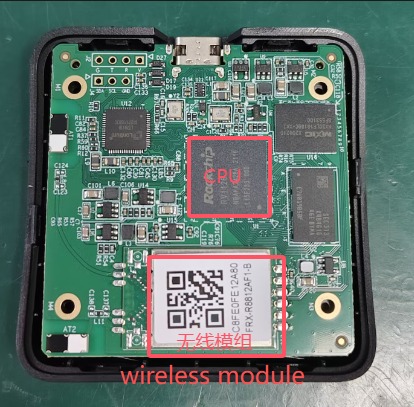
The WEB interface sends channel configuration commands to the system CPU
The CPU applies these settings to the wireless module through drivers
RF communication is fully executed by the Wi-Fi hardware module
This separation provides significant advantages:
Better thermal management
Superior wireless stability
Independent optimization of RF performance
Faster firmware iteration
Using only non-DFS channels ensures:
No forced channel switching due to radar detection.
No DFS scanning delays.
Ideal for AV integrators and IT managers deploying multi-room solutions.
Suitable for multi-hour conferences, training sessions, live streaming, and hybrid meetings.
For those deploying E900P and F21SU in Europe or similar regulatory regions, Boegam recommends:
Prefer channels 36–48 for maximum compatibility
Use “Auto Channel Optimization” in environments with heavy interference
Avoid physical obstructions when possible
Use 5GHz over 2.4GHz for highest stability and throughput
These simple practices further enhance transmission reliability.
The Boegam E900P + F21SU wireless presentation system is engineered with a clear priority: stability and low latency under real-world enterprise RF conditions.
By deliberately avoiding DFS channels and utilizing dedicated professional-grade wireless modules, the system delivers:
Reliable long-duration wireless operation
Low-latency A/V transmission (<150ms)
Smooth performance during corporate presentations
Robust BYOM support
High resilience to interference
As wireless presentation continues to evolve, Boegam remains committed to providing enterprise-grade, engineering-driven solutions that ensure performance you can trust in mission-critical environments.